
 Write a comment
Kenya boasts a rich diversity of both indigenous and exotic beef cattle breeds, each adapted to specific ecological zones and production systems. The following is an analysis of the major beef cattle breeds in Kenya, detailing their origins, physical characteristics, adaptability, growth rates, meat quality, and suitability for different regions.
National Cattle Breeds Catalogue and Official Breed Descriptions
The Kenya Livestock Breeds Catalogue, developed by the Ministry of Agriculture in collaboration with AU-IBAR, is the authoritative reference for breed descriptions, distribution, and utilization in Kenya. The catalogue classifies cattle into indigenous and exotic breeds, with further subdivisions based on ecotypes, regions, and production systems. It serves as a foundation for breeding interventions, conservation strategies, and policy development, and is central to the National Strategy and Action Plan (NSAP) for Animal Genetic Resources (AnGR).
Indigenous Beef Cattle Breeds in Kenya
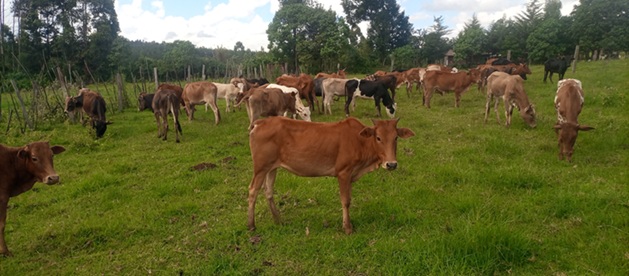
Indigenous beef cattle breeds dominate Kenya’s cattle population, particularly in ASALs and among pastoralist communities. These breeds have evolved adaptive traits through centuries of natural and farmer selection, enabling them to thrive under harsh climatic conditions, limited feed resources and high disease pressure. The main indigenous groups are the Boran (with subtypes: Kenyan Boran, Orma Boran, Somali Boran) and the Small East African Zebu (SEZ), which includes several local ecotypes.
Characteristics of Major Indigenous Beef Cattle Breeds in Kenya
|
Breed |
Origin/Region |
Coat Colour |
Adaptability |
Growth Rate (Mature Weight) |
Meat Quality |
Suitability (Regions) |
|
Maasai Zebu |
Southern Kenya, NE Tanzania |
Varied; black & white |
High drought & disease tolerance |
F: 275–385 kg, M: 300–445 kg |
Moderate |
Southern Kenya |
|
Kamasia/Samburu Zebu |
Samburu, Laikipia, Baringo |
Red/Brown, spotted |
Tolerant to ticks, drought |
F: 120–200 kg, M: 150–250 kg |
Low |
Central Kenya plains |
|
Winam/Kavirondo Zebu |
Western Kenya (Lake Victoria basin) |
Black, red, fawn, grey |
Tolerant to ticks, helminths |
F: 215–419 kg, M: 200–365 kg |
Moderate |
Western Kenya |
|
Nandi Zebu |
North Rift (Nandi) |
Variable |
Endangered; adapted to highlands |
F: 200–320 kg, M: 215–420 kg |
Moderate |
North Rift |
|
Watende Zebu |
Migori (Kuria) |
Black, brown, fawn |
Tolerant to diseases |
F: 150–220 kg, M: 200–280 kg |
Low |
South of Lake Victoria |
|
Coastal Zebu |
Taita Taveta, Kwale, Kilifi, Eastern |
White, black, patchy |
Adapted to coastal climate |
F: 125–360 kg, M: 194–405 kg |
Moderate |
Coastal and Eastern Kenya |
|
Teso Zebu |
Busia County |
Black, black/white |
Tolerant to ticks, adaptable |
Not specified |
Moderate |
Western Kenya |
|
Turkana/Karapokot Zebu |
Turkana, West Pokot, Baringo |
Brown/red to dark brown |
Highly adapted to rugged terrain |
Not specified |
Moderate |
North-western Kenya |
|
Kikuyu Zebu |
Muranga, Kirinyaga, Embu |
Black, grey, fawn |
Endangered; adapted to highlands |
Not specified |
Moderate |
Central Kenya |
|
Jiddu Zebu |
NE Kenya (bordering Somalia) |
Red/brown with white |
Large frame; adapted to drylands |
Not specified |
Moderate |
North-eastern Kenya |
|
Orma Boran |
Tana River, Garissa, Lamu, Kitui |
White to fawn |
Trypanotolerant, drought tolerant |
F: 130–200 kg, M: 250–350 kg |
Moderate |
Coastal and Eastern Kenya |
|
Somali Boran |
Garissa, Wajir, Mandera, Marsabit |
White with pigmented skin |
Highly adapted to drylands |
F: 150–250 kg, M: 200–400 kg |
Moderate |
North-eastern Kenya |
|
Kenyan Boran |
Laikipia, Nakuru, Machakos, Narok |
White, grey, brown |
Highly adapted, superior herding |
F: 380–450 kg, M: 500–850 kg |
High |
Ranching zones (ASALs) |
|
Kenyan Sahiwal |
Kajiado, Narok, Nakuru, Laikipia |
Reddish brown to chestnut |
Heat, drought, parasite tolerant |
F: 400–550 kg, M: 450–600 kg |
High |
Southern and Central Rift Valley |
Boran Cattle (Kenyan Boran, Orma Boran, Somali Boran)
- The Boran breed traces its roots to the Borana people of southern Ethiopia, with subsequent development in Kenya through selection and crossbreeding with Somali and Orma Boran, and some taurine influences. Genetic studies by ILRI have revealed a unique composition, combining Bos indicus (zebu), Near East-European Bos taurus, and native African taurine backgrounds.
- Boran cattle are medium to large-framed, with a prominent thoracic hump, well-developed dewlap, and a smooth, short coat that is typically white, grey, or brown. Bulls are notably larger than cows, with mature weights ranging from 500 to 850 kg for males and 380 to 450 kg for females.
- Boran cattle are renowned for their resilience in ASALs, exhibiting high drought tolerance, heat resistance, and strong resistance to ticks and certain diseases. The Orma Boran, in particular, is trypanotolerant, making it suitable for tsetse-infested regions.
- Improved Boran lines, developed through KALRO breeding programs, show average daily gains of 500–700 grams on natural grass, with steers reaching slaughter weights of 400 kg at 30–36 months. Carcass dressing percentages average 55%, and the meat is well-marbled, tender, and lean, fetching premium prices in domestic and export markets.
- Boran cattle are predominantly found in ASALs—Turkana, Samburu, Baringo, Laikipia, and Eastern Kenya—where their adaptability to poor-quality forage and harsh climates is unmatched.
- They are raised under pastoral, ranching, and increasingly, feedlot systems, with community breeding programs and commercial ranches (e.g., Lanet, Mutara, Transmara) playing key roles in breed improvement and multiplication.
- The Boran Cattle Breeders’ Society (BCBS) manages breed registration and improvement, while KALRO and ILRI conduct research and breeding trials. Community-based breeding systems and nucleus herds have been established to upscale climate-smart Boran genotypes in ASALs.
- The Orma Boran, kept by the Orma tribe in Tana River County, is the smallest Boran subtype, averaging 300 kg. It is highly trypanotolerant, with studies showing significantly lower mortality rates under tsetse challenge compared to other Boran lines. Orma Boran crossbreeding programs aim to inject trypanotolerance into improved Boran lines for use in tsetse-infested regions.
Small East African Zebu (SEZ) and Local Ecotypes
- SEZ cattle are indigenous to East Africa, with ecotypes named after the communities and regions where they are found—Maasai, Turkana, Nandi, Kikuyu, Winam, among others.
- SEZ cattle are small to medium-sized, with a prominent hump, short horns, and variable coat colors. They are hardy and well-adapted to low-input systems.
- These cattle excel in drought tolerance, disease resistance, and the ability to utilize poor-quality forage. Their resilience makes them the backbone of pastoral and smallholder systems in ASALs and humid regions.
- SEZ cattle have slow growth rates, with mature weights typically between 250 and 400 kg. Meat quality is moderate, with lower carcass yields compared to Boran and exotic breeds.
- SEZ ecotypes are distributed nationwide, thriving in pastoral, agro-pastoral, and mixed farming systems.
- They are managed under extensive grazing, nomadic pastoralism, and smallholder mixed farming. Their multi-purpose utility includes milk, meat, and draught power.
Several ecotypes (e.g., Nandi, Kikuyu Zebu) are endangered due to genetic erosion from indiscriminate crossbreeding and inadequate conservation programs.
Sahiwal
- The Sahiwal breed originates from the Punjab region of Pakistan and India. It was introduced to Kenya between 1939 and 1963, with the National Sahiwal Stud at Naivasha maintaining purebred lines.
- Sahiwal cattle are medium to large-framed, with a reddish-brown to chestnut coat, long drooping ears, and a well-developed thoracic hump. Bulls are masculine and alert, while cows are feminine and calm.
- Sahiwal cattle are highly tolerant to heat, drought, and ticks, making them ideal for semi-arid and tropical environments. They perform well on poor-quality pastures and under low-input management.
- Sahiwal steers show rapid growth rates, with daily gains of 470–511 grams and mature weights of 400–600 kg. Carcass quality is good, with lean meat and even fat distribution. The breed is dual-purpose, valued for both milk and beef.
- Sahiwal cattle are reared in southern and central Rift Valley, coastal regions, and highland ranches.
- They are managed in ranching, agro-pastoral, and smallholder systems, often used as dams in crossbreeding programs with Boran and exotic breeds.
- The Sahiwal Breed Society of Kenya registers and conserves purebred lines, while KALRO and ILRI promote breed improvement and crossbreeding for enhanced productivity.
Exotic Beef Cattle Breeds
Exotic beef breeds were introduced to Kenya primarily for commercial ranching and feedlot systems, targeting improved growth rates, carcass yields, and meat quality. These breeds require higher management inputs and are best suited to high-potential areas with access to quality feed and veterinary services.
Characteristics of Exotic Beef Breeds in Kenya
|
Breed |
Origin |
Coat Color |
Adaptability |
Growth Rate (Mature Weight) |
Meat Quality |
Suitability (Regions) |
|
Charolais |
France |
White/cream |
Moderate; needs inputs |
Bulls: up to 1,000 kg |
Excellent |
Highlands, feedlots |
|
Hereford |
UK |
Red with white face |
Moderate; temperate zones |
Bulls: up to 1,000 kg |
High |
Highlands, ranches |
|
Angus |
Scotland |
Black/red, polled |
Moderate; cooler climates |
Bulls: up to 900 kg |
Premium |
Highlands, commercial ranches |
|
Simmental |
Switzerland |
Red/white |
Moderate; high rainfall |
Bulls: up to 1,000 kg |
Good |
Highlands, ranches |
|
Charbray |
Composite |
White/cream |
High heat/tick resistance |
Bulls: up to 1,000 kg |
High |
ASALs, feedlots |
|
Santa Gertrudis |
USA |
Red |
High heat/tick resistance |
Bulls: 500–800 kg |
Good |
ASALs, ranches |
Charolais
Charolais cattle are large-framed, late-maturing, and produce lean carcasses with high meat-to-bone ratios. They exhibit rapid growth rates (up to 1.2 kg/day) and high slaughter weights, making them ideal for feedlot and intensive ranching systems in highland areas. However, purebred Charolais are less suited to ASALs due to climate sensitivity. Crossbreeding with indigenous breeds (e.g., Boran, Nguni) improves adaptability and carcass traits.
Hereford
Hereford cattle are medium to large-framed, with red bodies and white faces. They are known for quick weight gain, high-quality beef with good marbling, and easy calving. Herefords perform best in temperate highland ranches and are used in crossbreeding to enhance beef traits in local herds.
Angus
Angus cattle, originally from Scotland, are black or red, polled, and medium-framed. They are prized for premium beef with excellent marbling and tenderness. Angus perform well in cooler highland climates and are increasingly adopted by commercial ranches targeting hotel and export markets.
Simmental
Simmental cattle are large-framed, with red and white coats. They show rapid weight gain, high carcass yields, and lean meat. Simmental crosses are popular in highland and medium rainfall areas, especially in semi-intensive and zero-grazing systems.
Charbray and Santa Gertrudis
Charbray (Charolais × Brahman) and Santa Gertrudis (Shorthorn × Brahman) are composite breeds developed for improved heat and tick resistance, rapid growth, and high carcass yields. They are suitable for ASALs and feedlot systems, combining the hardiness of Brahman with the growth traits of Charolais or Shorthorn.
Crossbreeding Programs and Composite Breeds
Boran × Sahiwal and Boran × Red Poll
Crossbreeding programs led by KALRO and community ranches aim to combine the hardiness and adaptability of Boran with the growth and carcass traits of Sahiwal and Red Poll. Boran × Sahiwal crosses show rapid growth rates (up to 1.07 kg/day), high slaughter weights (450–600 kg), and efficient feed conversion, making them ideal for feedlot finishing and ASALs.
Boran × Red Poll crosses are bred for improved milk production and fast-growing steers with high-quality meat, adaptable to arid and semi-arid areas.
Composite Breeds and Community-Based Breeding
KALRO’s long-term objective is to develop Kenyan beef composite breeds with enhanced adaptability, productivity, and resilience to climate change. Community-based breeding systems, nucleus herds, and multiplier farms have been established in ASAL counties (e.g., Isiolo, Marsabit) to upscale climate-smart genotypes.